What a mold risk score is
A mold risk score — what Mold IQ scoring produces — estimates how favourable a property's conditions are to mold growth, from building, climate and water-history records, without anyone entering the house.
What it is not
It is not a test. A test kit or an air sample collects material from inside a building and a laboratory says what is in it. A risk score never touches the building; it reasons from records about the structure, its site and its history.
It is not a diagnosis. Nothing about a score says whether anyone in the house is unwell, or why. That question belongs to a clinician with the person in front of them, and no property model can answer it.
It is not a detection. This is the distinction most worth holding on to: a risk score cannot tell you there is mold behind your bathroom wall. A property can score Severe with nothing growing in it, and score Low with a colony behind a shower pan that failed last winter. The score is about conditions. The colony is a fact, and facts need looking.
Why probability of conditions is a different question
Mold needs three things: spores, which are everywhere and cannot be excluded; organic material, which every building is made of; and water. Only water is variable, so the useful question about a building is not whether spores are present but whether water reaches materials and stays.
That question can be answered from the outside. How humid the region is and how much rain the envelope has to shed. Whether the site drains or collects. What the building is made of and how that assembly fails. Whether water has already got in, on the record. None of that requires entering the house, and all of it moves the odds.
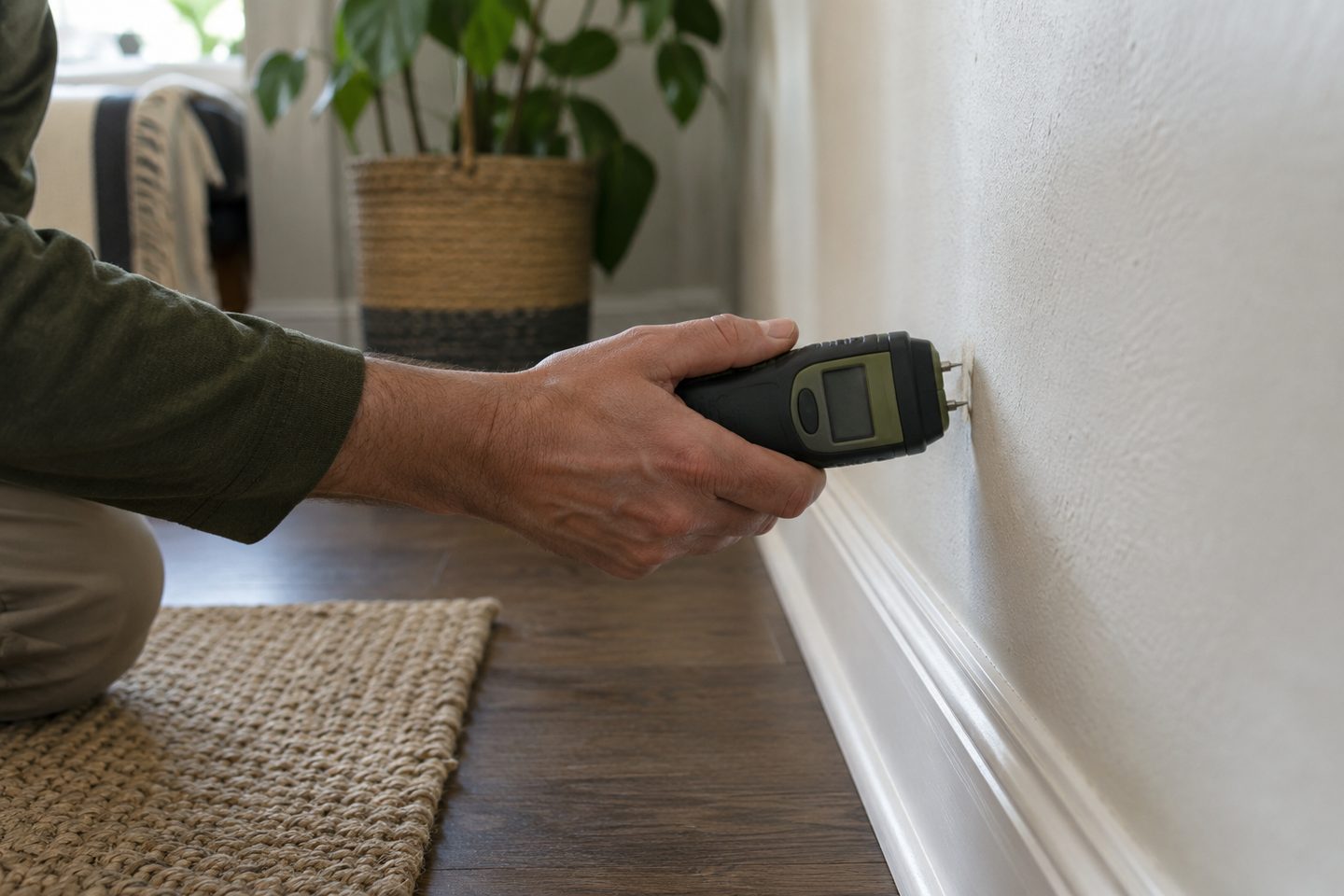
The question that cannot be answered from the outside is whether growth exists right now. That takes a person with a moisture meter, or a sample and a laboratory. A score is what you use to decide whether that is worth arranging, and where they should look first.
The scale and what its ends mean
Scores run from 0 to 100, with five bands. Low is below 20: nothing in the record suggests conditions that favour growth. Guarded runs to 39. Elevated runs to 59. High runs to 79. Severe is 80 and above, which means several independent factors point the same way, usually including something documented rather than inferred.
Bands exist because precision would be dishonest. The difference between 54 and 56 is not a difference anyone should act on; the difference between Elevated and High is. Read the band, then read what produced it.
A score always arrives with its data completeness reported separately. A 55 built from a verified construction year, a parcel record and a filed disclosure is a much stronger claim than a 55 built from a census-tract median and a postal code — and a single number that hid the difference would be the more useful-looking and less honest of the two.
What goes into the number
Four weighted modules. Regional Moisture Burden is worth 20 points and covers the climate the building has to cope with — humidity, rainfall, flood exposure, storm exposure. Terrain and Drainage is worth 10 and covers where the building sits on its land. Building Vulnerability is worth 25 and covers construction era, exterior materials, roof form and below-grade space. Disclosure and Event History is worth 45 and covers what is actually on the record about this address.
The disclosure module is the largest deliberately. Everything else is inference about a category of building; a filed disclosure describing a basement that floods is evidence about this one. When the people living in a building complete a structured intake, Occupant Observations adds up to 20 points more, and it is the only input that comes from inside.
Each factor carries an evidence strength that decides how much of its weight applies — a detail confirmed by an inspection counts for more than one confirmed on paper, which counts for more than one inferred from the building's cohort. And documented, unresolved water intrusion sets an evidence floor: a minimum the score cannot fall below however favourable everything else looks.
Where it sits next to a test kit and an inspection
A risk score is the cheapest and fastest of the three and the only one that works before you have access to a property. It is also the only one that cannot confirm anything. Use it to decide whether to spend money, and where.
A test kit identifies what is growing on a surface or in the air at one spot. It answers a narrow question well and tells you nothing about how far the problem extends or where the water came from.
An inspection sends a person with moisture meters and usually a thermal camera to find where water is getting in and what it has reached. It is the answer to the question the other two raise. A score that comes back High with a documented leak in the record is not a reason to buy a test kit; it is a reason to have someone look.
Coverage and honest limits
The full model runs in Pennsylvania, New Jersey and Delaware, where the soil and terrain profiles are built out and the state disclosure forms — the PA SPD, the NJ SPCDS and the DE SDCR — can be read and normalised. Addresses outside those states still score, on climate, terrain and building data, without the disclosure layer.
Property records are imperfect everywhere. Where a construction year comes from a parcel record or from the owner it is treated as verified; where it comes from a census-tract median or a community-mapped building footprint it is treated as an estimate and the report says so on the line where it is used. A model that presented a neighbourhood median as a fact about your house would score confidently and be wrong quietly.
In this section
Questions people ask
- Does a high mold risk score mean my house has mold?
- No. It means conditions favour growth. A property can score Severe with nothing growing and Low with an active problem behind a wall. The score tells you whether looking is worth it and where to start.
- Can a mold risk score replace an inspection?
- No, and it is not meant to. It never enters the building. It is the step before an inspection — the one that decides whether to book one and what to point the inspector at.
- What does Mold IQ analyze?
- Regional climate, site terrain and drainage, the building's construction era and materials, and its documented disclosure and hazard-event history. Occupant answers about what they have seen and smelled can be added afterwards.
- How accurate is it?
- Accuracy depends on how much is known about the property, which is why data completeness is reported next to the score rather than folded into it. A score built from verified records is a far stronger claim than one built from regional estimates.
- Is a mold risk score the same as a Mold IQ score?
- A mold risk score is the general category. The MoldRiskIQ score is one specific model within it, with a 0–100 scale and four named modules whose weights are published.