Moisture risk
How to get a moisture risk score for a house: enter the address. Moisture is the modelable variable behind mold, and it also drives rot, corrosion and envelope failure.
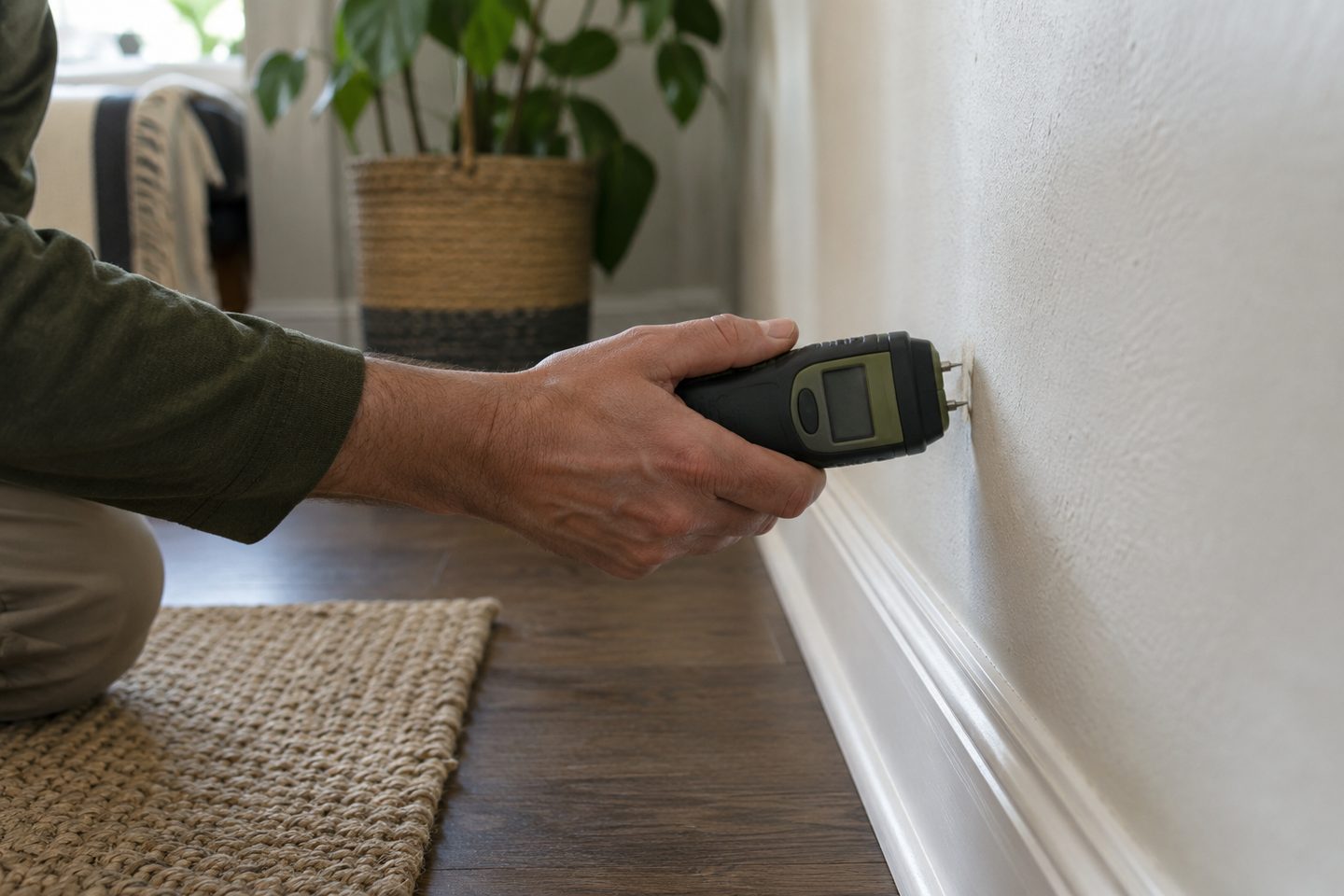
Why moisture is the variable, not mold
Mold needs three things. Spores, which are in every building on earth and cannot be excluded. Organic material, which every building is made of. And water. Only the third is variable, and only the third is something anyone can change.
That makes moisture the modelable quantity. You can reason from records about how much water a building has to shed, how readily its site drains, how its assemblies dry, and whether water has already got in — all without entering it. You cannot reason from records about whether a colony is currently growing, because nothing writes that down.
It is also the more useful quantity, because moisture does damage that has nothing to do with fungi. Framing decays. Fasteners and connectors corrode. Wet insulation loses most of its thermal value, which shows up as a heating bill rather than as a defect, and the colder surfaces that follow make condensation more likely — a loop that accelerates.
How moisture risk and mold risk relate
Mold risk is a subset. Every property with a mold problem has a moisture problem; the reverse does not hold. Materials can be wet without growth if they dry fast enough, or if they are inorganic, and they are still being damaged.
The practical consequence shows up in how work gets bought. A homeowner who believes they have a mold problem buys mold removal. A homeowner who understands they have a moisture problem buys a repair, and the removal becomes one line in it. The second is the one that holds.
It is also why remediation that removes growth without correcting the source reliably fails. The symptom was treated. The water still arrives on the same schedule it always did.
The mechanics, briefly
Air holds more water when it is warm, so cooling air raises its relative humidity without adding a drop. Cool it far enough and it reaches its dew point and condenses.
Every building has surfaces colder than its air — framing that bridges heat to the outdoors, the inside face of an uninsulated wall, a closet floor on a north elevation. The air touching those surfaces is the same air a hygrometer reads, at a lower temperature, and therefore at a higher relative humidity. That local figure is what the material experiences.
Growth follows water activity at the surface: roughly 0.80 for the common indoor genera, about 0.90 for Stachybotrys, which is why the latter indicates a sustained liquid source rather than incidental humidity. This is the whole explanation for a house reading a comfortable 45% that nonetheless has growth behind a wardrobe.
What gets read
Regional moisture load — humidity, rainfall, flood and storm exposure — which sets the background pressure a building works against and is identical for everything in a postal code.
Site terrain and drainage, from elevation data at the property's coordinates. This is the class that most often explains why one house on a street is wet and its neighbour is not, and it is measured rather than reported.
The building's own characteristics: construction era, cladding, roof geometry, below-grade exposure. Era decides what the assembly is made of and how it fails, and the curve is not what most people expect — 1990s stock is the model's worst decade, because tightened envelopes without matched ventilation lost the drying capacity that made older, leakier buildings forgiving.
Documented water history, from state disclosure forms and federal hazard records. This is the only class that is evidence about this building rather than inference about buildings like it, and it carries the most weight for exactly that reason.
What it is for
Deciding where to spend attention. Across a purchase, a portfolio or an underwriting book, a moisture estimate orders properties by how much scrutiny they warrant — which is a cheaper question to answer than sending someone to each of them.
Pointing an inspection. A survey arrives more useful when the surveyor already knows the building is 1994 stucco on low-lying ground with a disclosed basement event, because it changes where they start.
It is not a substitute for either. It never enters the building, and there is a page on exactly how accurate that makes it and where it goes wrong.
In this section
Questions people ask
- How do I evaluate moisture risk for a property?
- From the outside: regional climate, how the site drains, what the building is made of and when, and whether water has already been documented getting in. From the inside: a hygrometer in two rooms and an infrared thermometer against any cold patch.
- Is moisture risk the same as flood risk?
- No, and the confusion is costly. Flood risk is about inundation from outside. Most moisture damage in housing comes from failed supply lines, condensation and roof or envelope details — none of which appear in a flood map.
- What indoor humidity should I hold?
- 30% to 50% through the cooling season, measured in more than one room. A basement and an upstairs room frequently differ by more than either occupant expects.
- Can a dry-looking building have high moisture risk?
- Routinely. Risk describes propensity, not condition. A building that has never had a problem can be one failed detail away from one, and a building that looks damp may be drying perfectly well.